

Mobility World guide • Battery advice • UK rules • Trading since 1990 • Harrow & Letchworth showrooms
AGM vs Gel vs Lithium Mobility Scooter Batteries: Simple UK Guide
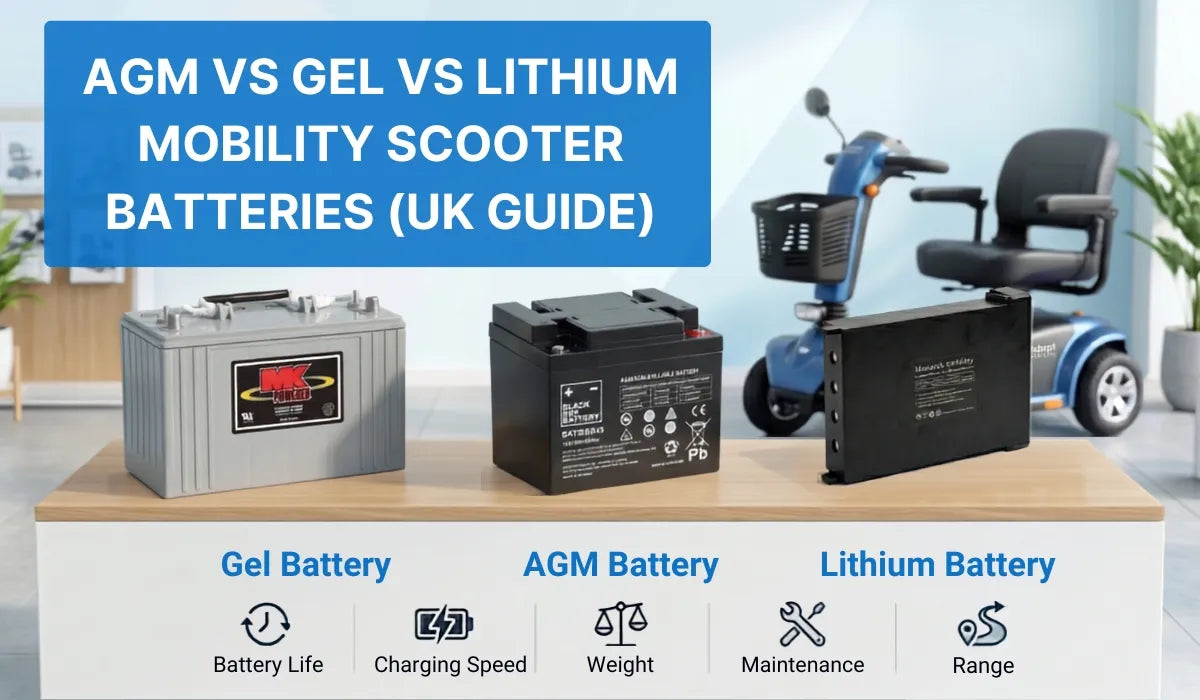
The Quick Answer: There are three main battery types used in mobility scooters in the UK — AGM (Absorbent Glass Mat), Gel, and Lithium. AGM batteries are affordable and widely compatible. Gel batteries suit irregular charging patterns and warm storage. Lithium batteries are the lightest and longest-lasting, ideal for folding and travel scooters. The right choice depends on your scooter model, how often you charge, and where you store your equipment. Mobility World stocks replacement batteries and can advise on the correct type for your scooter.
What are AGM, Gel and Lithium batteries?
All three battery types are used in mobility scooters across the UK. They all deliver the electrical power your scooter needs, but they differ in construction, weight, charging behaviour, and long-term cost.
AGM (Absorbent Glass Mat) batteries
AGM batteries are sealed lead-acid batteries where the electrolyte is absorbed into fibreglass matting. They are the most common type fitted to UK mobility scooters, especially mid-range and entry-level models. They charge quickly, cope well with regular use, and are widely available as replacements.
- Good value and widely available
- Compatible with the majority of UK scooter models
- Suited to regular, daily charging routines
- Heavier than lithium alternatives
Gel batteries
Gel batteries are also sealed lead-acid, but the electrolyte is suspended in a silica-based gel. They are more tolerant of deep discharge and inconsistent charging than AGM, making them a better fit for people who use their scooter occasionally or don't charge after every trip.
- Handles irregular charging better than AGM
- Slightly more vibration-resistant
- Similar weight to AGM
- Requires a gel-compatible charger — do not use an AGM charger with a gel battery
Lithium batteries
Lithium (typically Lithium Iron Phosphate / LiFePO4) batteries are the most advanced option. They are significantly lighter than lead-acid types, have a longer lifespan, and hold their charge for longer when not in use. They are increasingly fitted to folding and travel scooters where weight is critical.
- Up to 50–60% lighter than equivalent AGM or Gel
- Longer lifespan — typically 3–5x more charge cycles
- Retain charge well during storage
- Higher upfront cost, but lower long-term replacement cost
- Requires a lithium-specific charger
AGM vs Gel vs Lithium: Quick Comparison
| Feature | AGM | Gel | Lithium |
|---|---|---|---|
| Weight | Heavy | Heavy | Lightweight (up to 60% lighter) |
| Typical lifespan | 1–2 years | 1–3 years | 4–8 years |
| Charging routine | Regular (after every use) | Tolerates irregular charging | Flexible — holds charge longer |
| Charger required | AGM-compatible | Gel-specific charger | Lithium-specific charger |
| Best for | Everyday scooter users | Occasional users | Folding/travel scooters |
| Upfront cost | Lower | Mid-range | Higher |
Not sure which battery type your scooter uses? Contact our team for guidance, or browse our full replacement battery range.

Which battery type is right for your scooter?
The single most important rule: always match your replacement battery to your scooter's original specification. Fitting the wrong type — particularly using an AGM charger with a Gel battery, or vice versa — can reduce performance, shorten battery life, or void your warranty.
Beyond that, these questions help narrow the choice:
- Do you charge after every use? AGM suits regular daily charging well.
- Do you charge irregularly or store the scooter for weeks at a time? Gel or Lithium are more tolerant.
- Is weight important? If you lift your scooter into a car boot or use a folding model, Lithium reduces the load significantly.
- What's your budget? AGM is the most affordable upfront. Lithium costs more initially but typically lasts longer.
If you're unsure, Mobility World's engineers can advise on the correct type and capacity for your specific model. Get in touch with our team.
What affects battery range on a mobility scooter?
Battery type is only one factor in how far your scooter travels on a single charge. Range is also affected by:
- Terrain — hills, kerbs, and rough surfaces drain power faster than flat paths
- Rider weight — heavier loads reduce range
- Temperature — cold weather reduces battery performance, especially in older lead-acid batteries
- Speed setting — higher speeds use more power
- Battery age — capacity degrades over time with repeated charge cycles
- Charging habits — deep discharging before recharging accelerates wear in AGM batteries
If your scooter's range has noticeably decreased, the battery may need testing or replacement. Our engineers can assess battery health as part of a routine service.
Battery testing, replacement and servicing
Mobility World's own engineers — not third-party contractors — carry out battery testing and replacement across our Harrow and Letchworth service areas, covering Hertfordshire, Bedfordshire and North West London.
- Battery health diagnostics — assess remaining capacity and charge performance
- Correct battery matching — ensures the replacement type and voltage are correct for your scooter
- Charger compatibility check — vital if switching between battery types (e.g. AGM to Gel or Lithium)
- Workshop and mobile engineer support — servicing at our showrooms or at your home where appropriate
VAT relief on replacement mobility scooter batteries
Replacement batteries for mobility scooters typically qualify for zero-rated VAT when purchased by a person with a qualifying disability or long-term illness. Eligible customers self-declare at the point of purchase.
Our team provides clear VAT relief guidance as part of every sale — no complicated paperwork required.
Batteries, chargers and scooter accessories
- Replacement batteries — AGM, Gel and Lithium options
- Scooter accessories — covers, bags, canopies, cup holders, lights
- Boot hoists — for easy scooter loading without heavy lifting
- Portable ramps
Mobility scooters by type — and which battery suits each
Class 2 Pavement Scooters
Class 2 pavement scooters travel at up to 4 mph on pavements. Most use AGM or Gel batteries. Regular daily charging is recommended.
Class 3 Road Scooters
Class 3 road scooters travel at up to 8 mph and cover longer distances. They typically carry larger AGM or Gel batteries to support extended range.
Folding & Boot Scooters
Folding and boot scooters benefit most from Lithium batteries — lower weight makes lifting into a car boot significantly easier.
Power Wheelchairs
Powerchairs also use sealed lead-acid or lithium batteries depending on the model. Battery type and capacity should always be confirmed before replacement.
Other mobility equipment from Mobility World
Helpful Mobility World resources
- Mobility scooters – browse all models
- Class 2 pavement mobility scooters
- Class 3 road mobility scooters
- Portable boot scooters
- Folding mobility scooters
- Approved used mobility scooters
- Motability leasing options
- Support and servicing via our Letchworth hub
- Support and servicing via our Harrow hub
- Free expert advice
- Contact us
About Mobility World
Mobility World is a UK mobility equipment specialist serving customers since 1990 through showrooms in Harrow and Letchworth Garden City.
Our team helps customers choose mobility scooters, powerchairs, adjustable beds and daily living aids through suitability assessments, home delivery, installation and ongoing servicing and repairs.
Visit our showrooms:
- Harrow showroom – 78-80 Station Road, Harrow, Middlesex HA1 2RX
- Letchworth showroom – Birds Hill, Letchworth Garden City, SG6 1HX
Customers can test equipment in store or arrange home assessments across Hertfordshire, Bedfordshire, Cambridgeshire, North London and North West London.
Why Trust Mobility World?
Since 1990, we have been far more than an online retailer. Our advice is backed by:
- Physical Showrooms: Visit us in Harrow or Letchworth for hands-on demonstrations and expert guidance.
- Trading Standards Approved: Buy with Confidence — independently verified consumer protection.
- Driving Mobility Approved: PWMS Trained and Accredited — recognised professional standards in powered wheelchair and mobility scooter assessment.
- Expert Engineers: Our own mobile engineers provide lifetime support, servicing and repairs — not third-party contractors. That means accountability and continuity of care.
- 0% Finance Available: Spread the cost with interest-free finance options on selected products.
- Price Match Promise: Found it cheaper elsewhere? We'll match it — see our Price Match Promise.
Ready to find the right battery or scooter?
Browse replacement batteries online, speak to our team for advice, or arrange a service visit.
People also ask about mobility scooter batteries
What is the difference between AGM and Gel mobility scooter batteries?
Both are sealed lead-acid batteries, but they differ in how the electrolyte is held. AGM batteries use fibreglass matting and suit regular daily charging. Gel batteries use a silica-gel suspension and are more tolerant of irregular or infrequent charging. They also require different chargers — using an AGM charger on a Gel battery can cause damage.
Are lithium batteries worth it for a mobility scooter?
Lithium batteries are significantly lighter than AGM or Gel, making them especially worthwhile for folding or travel scooters where weight matters. They also last longer and hold their charge during storage. The higher upfront cost is often offset by a longer service life and fewer replacements over time.
How long does a mobility scooter battery last?
AGM batteries typically last 1–2 years with daily use. Gel batteries may last slightly longer with proper care. Lithium batteries have a considerably longer lifespan — often 4–8 years depending on usage. Range and lifespan are both affected by terrain, rider weight, temperature, and charging habits.
Can I replace an AGM battery with a Lithium battery on my scooter?
In some cases yes, but this depends on your scooter model. The voltage and physical dimensions must be compatible, and you will need a lithium-specific charger. Always confirm compatibility with an engineer before switching battery chemistry. Mobility World can advise — contact our team.
Do mobility scooter batteries qualify for VAT relief?
Yes. Replacement batteries for mobility scooters typically qualify for zero-rated VAT when purchased by a person with a qualifying disability or long-term illness. Customers self-declare at the point of sale. See our VAT relief guidance.
Frequently asked questions — AGM, Gel and Lithium mobility scooter batteries
What type of battery does my mobility scooter use?
Most UK mobility scooters come fitted with either AGM or Gel sealed lead-acid batteries. Folding and travel scooters increasingly use Lithium (LiFePO4) batteries. Check your scooter's user manual or the battery label for the type and voltage. If you're unsure, our team can help identify the correct replacement.
Can I use any charger with my battery?
No. AGM and Gel batteries require different chargers. Using an AGM charger on a Gel battery can cause overcharging and premature failure. Lithium batteries also need a lithium-compatible charger. Always use the charger supplied with your scooter or a verified replacement of the correct type.
How do I know if my mobility scooter battery needs replacing?
Common signs include noticeably reduced range, slower acceleration, the battery warning indicator coming on sooner than usual, or the battery taking longer to charge. If you notice any of these, a battery health check is recommended. Mobility World can carry out diagnostics at our Harrow or Letchworth workshops.
Does cold weather affect my scooter battery?
Yes. Cold temperatures reduce the performance of all battery types, particularly lead-acid (AGM and Gel). Expect reduced range in winter. Store your scooter indoors where possible, and keep the battery charged during periods of non-use. Lithium batteries are generally more cold-tolerant than AGM or Gel.
How should I store my mobility scooter battery?
Store your scooter in a dry, indoor environment away from extreme temperatures. For lead-acid batteries (AGM/Gel), keep the battery fully charged during long periods of storage and top up every few weeks. Lithium batteries hold their charge better during storage and require less maintenance charging.
Can Mobility World replace my battery at home?
Our mobile engineers can support battery diagnostics and replacement at home for customers across Harrow, Letchworth, Hertfordshire, Bedfordshire and North West London, where appropriate. Alternatively, bring your scooter to our Harrow or Letchworth showroom for a workshop service.
Do I need to register my new scooter battery?
Registration requirements vary by manufacturer. Some battery and scooter warranties require product registration. Check the documentation supplied with your replacement battery, or ask our team at the point of purchase for guidance.
Next steps — batteries, servicing and scooters
Browse replacement batteries online or speak with our team for expert guidance on the right type for your scooter.
Shop Replacement Batteries | Browse Mobility Scooters | Contact Our Team
For local support: Mobility World Harrow hub | Mobility World Letchworth hub
Expertise Verified By: PS
Reviewed by the Mobility World Specialist Team
Based on 35+ years of hands-on experience in our Harrow and Letchworth showrooms, Buy with Confidence trading standard approved, and Driving Mobility PWMS trained and approved


