
Motability powerchair battery range figures are maximum estimates, so your everyday journeys should leave a comfortable reserve for getting home. Hills, cold weather and battery condition can all reduce the distance you travel between charges.
The right chair needs enough spare capacity for your routine, alongside suitable seating and controls. Start with your actual routes, then compare battery specifications and charging arrangements.
Key takeaways for reliable journeys
- Treat the manufacturer's quoted range as an upper estimate, not a guaranteed travelling distance.
- Plan the whole return journey, including diversions, and build up distance through shorter outings.
- Charge according to your chair's instructions and report a noticeable loss of range before attempting longer trips.
What quoted powerchair range means
Controlled testing differs from everyday travel
Manufacturers calculate maximum range under controlled conditions. Scooter range testing follows the ISO standard. It uses a circuit travelled in both directions, with a 100 kg load at approximately 20°C under ideal conditions.
Those conditions cannot reproduce every pavement, slope or winter morning. Powerchair specifications also depend on the model, battery configuration and test method, so scooter figures don't automatically describe wheelchair performance.
A maximum range therefore helps you compare specifications, but it cannot promise how far your chair will travel.
Understanding C5 and amp-hours
The C5 battery rating describes capacity measured over five hours, expressed in amp-hours (Ah). It tells you how much electrical charge a battery supplies under that test.
A higher Ah figure can support longer travel when comparing otherwise similar batteries. However, voltage, battery chemistry, chair efficiency and carrying weight also matter.
Compare like-for-like specifications rather than assuming that doubling Ah always doubles usable range.
Why your powerchair may travel fewer miles
The route and weather change energy demand
Climbing hills and crossing soft or uneven terrain require more energy than travelling along smooth, level paths. Repeated stopping, acceleration and tight joystick-controlled turns also affect consumption.
Average speed matters, too. A journey through busy shopping areas differs from steady travel on an unobstructed path, even when both cover the same distance.
A lower temperature can temporarily reduce available battery capacity, so a familiar summer route may leave less charge in winter.
The chair, battery and passenger matter
User weight, luggage and accessories affect the total load. Powered seating functions also draw energy, although their effect depends on how often you use them.
Battery condition matters, as older batteries usually hold less charge than healthy newer ones. An incomplete charge can also leave you starting below full capacity.
Underinflated pneumatic tyres increase rolling resistance. Use the specified pressure where applicable, and arrange attention for damaged tyres or brakes that appear to drag.
Compare named models without confusing categories
These published maximums illustrate how widely specifications differ across powered wheelchairs and mobility scooters.
| Model | Quoted maximum range |
|---|---|
| Monarch Ezi-Fold Carbon | Up to 7.5 miles |
| Pride Jazzy Assist | Up to 8.49 miles with 10 Ah; 16.9 miles with 20 Ah |
| GoGo Carbon Ultralite | Up to 9.3 miles |
| GoGo Endurance AL+ | 9 or 18 miles, depending on battery option |
| Excel Galaxy Compact II EVO | Up to 66 miles |
| Quantum Rehab Edge 4 powerchair | Up to 18.1 miles |
The Excel Galaxy Compact II EVO is a mobility scooter; the Edge 4 is a powered wheelchair. Their figures aren't directly comparable. The Jazzy Assist figures also show why the battery option belongs beside the headline mileage.
Range alone shouldn't decide the choice. A larger outdoor scooter may offer considerable distance but lack the indoor manoeuvrability or seating support you need.
Check your Motability Scheme eligibility before choosing a lease. Our Motability scooter and powerchair leasing range includes options such as the Rascal Rio, Pride I-GO and Rascal Ryley. Compare everyday suitability before choosing extra capacity.
Plan the return journey before setting off
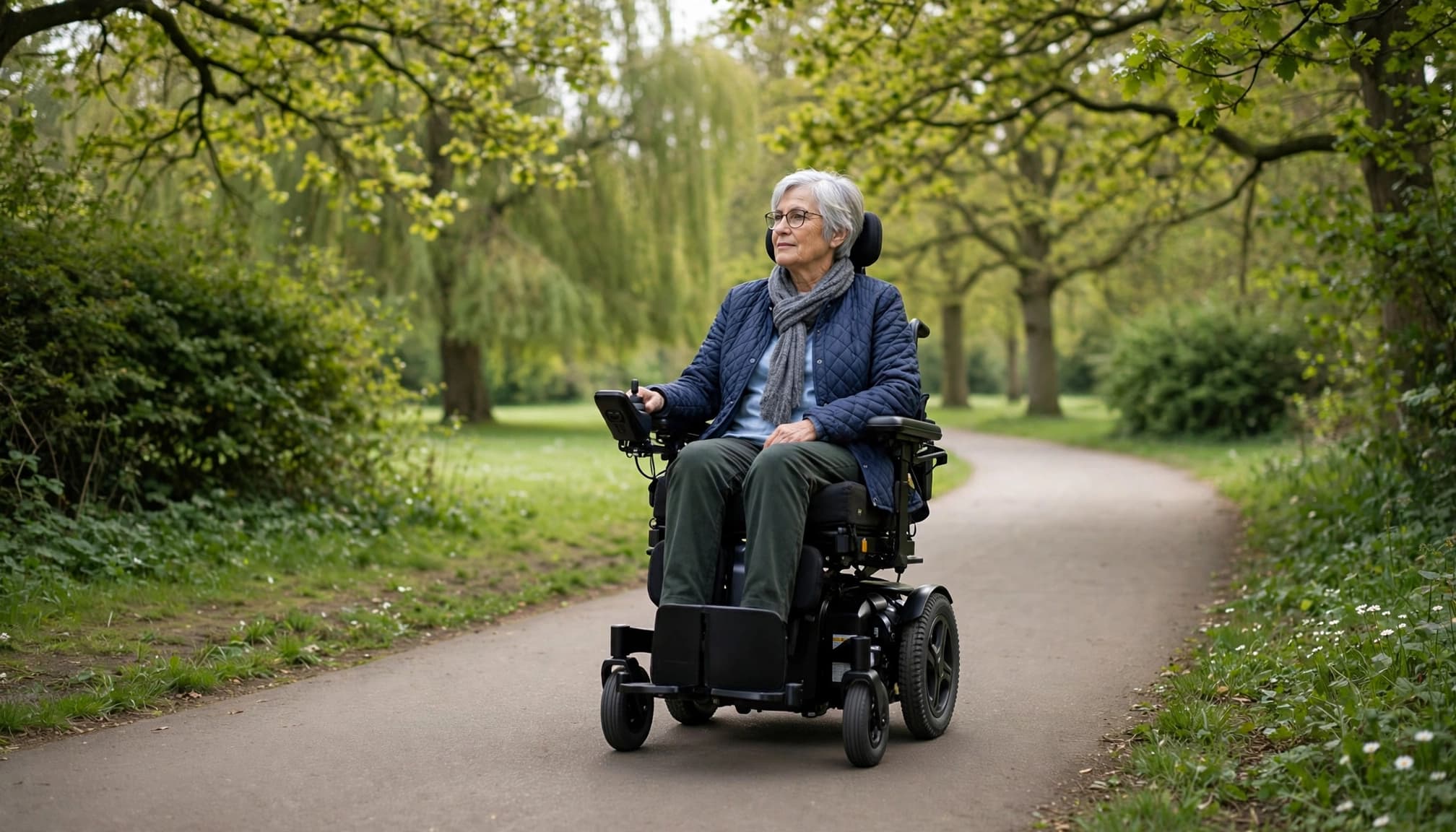
Count the complete outing, including movement inside shops, station approaches and possible diversions. A destination five miles away requires at least ten miles of travel, before those additions.
For the Edge 4's quoted 18.1 miles, reserving one-third leaves roughly 12 miles for planning, or six miles each way. This calculation allows for a reserve, but it doesn't establish your chair's real-world range.
A one-third reserve cannot compensate for every combination of steep hills, cold weather and worn batteries.
Begin with shorter, familiar routes. Record the distance, terrain, weather and gauge reading when you return. Your own journey record is more useful than another user's mileage.
Don't assume a café or venue will let you use a socket. Confirm that it's accessible, that you have permission and that there's enough time for a top-up.
Charge batteries correctly and avoid damaging routines
Identify the battery system first
Many full-size powerchairs use two 12 V batteries connected as a 24 V system. Gel and AGM are both sealed lead-acid technologies; some lightweight chairs use lithium batteries instead.
These systems need compatible chargers and different care instructions. Never substitute a charger because its plug appears to fit.
Time to restore capacity depends on battery capacity, remaining charge and charger output. Lead-acid systems often need an overnight charge, but the manufacturer's instructions determine the correct routine.
Follow a consistent charging routine
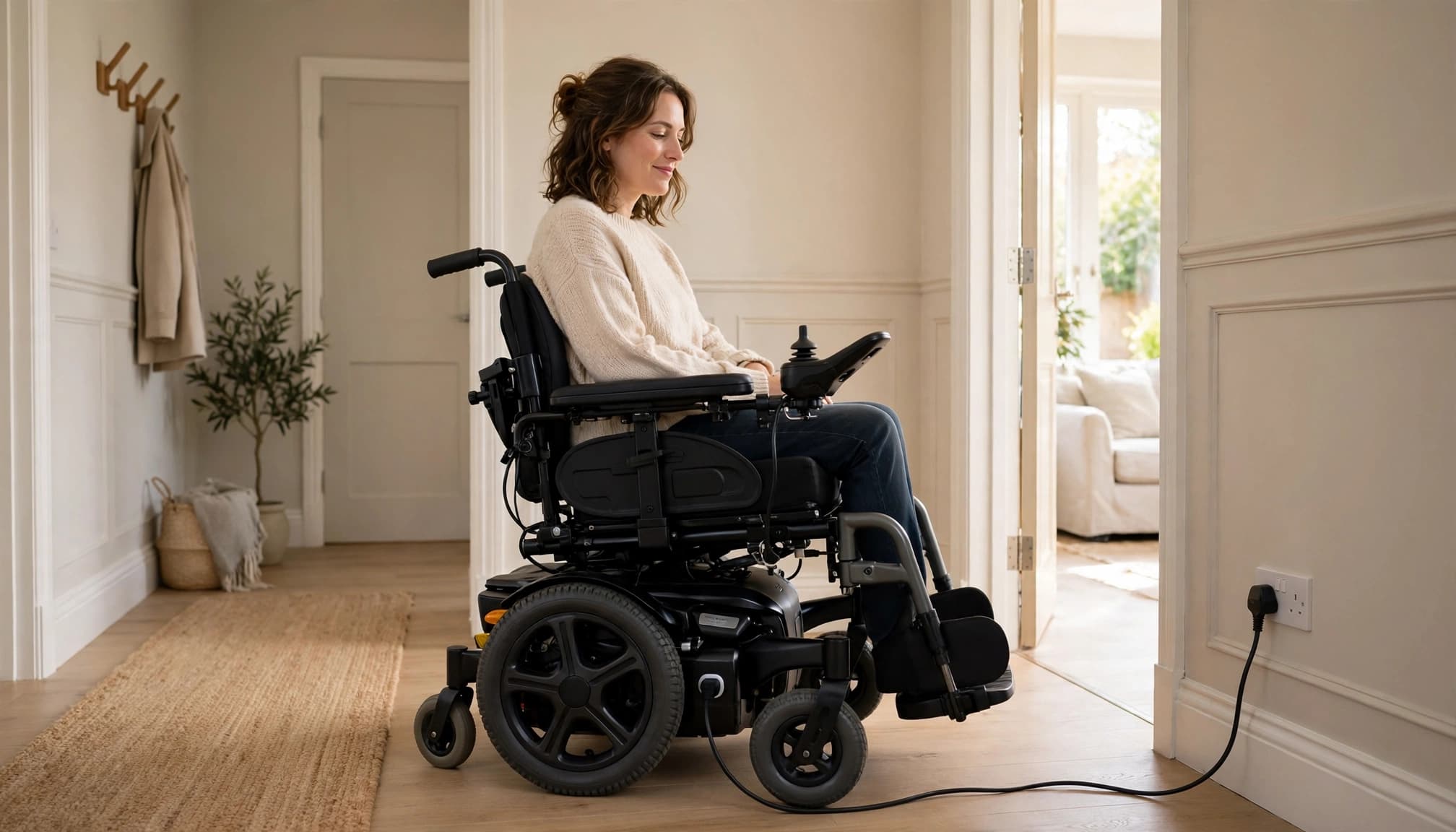
- Fully charge new batteries before first use, following the supplied instructions.
- Recharge lead-acid batteries after use. During storage, follow the specified maintenance schedule; some systems need a weekly top-up.
- Use a dry, ventilated area, with cables clear of walkways and exits.
Older gel-battery advice sometimes recommends waiting until the gauge reads low. Other guidance mentions discharge cycles every two months after around 20 charges. Don't adopt deliberate deep discharge as a general maintenance routine.
Gel and other sealed lead-acid batteries can suffer damage when run flat. Lithium batteries also need their own manufacturer's charging and storage procedure.
Use the Motability delivery handover to practise connecting your charger and recognising its indicators. Don't leave questions about the charger until your first long outing.
Choose routes that match your chair's legal class
A Class 2 mobility scooter or powered wheelchair has a maximum speed of 4 mph and doesn't need DVLA registration. These models are primarily for pavements and pedestrian areas.
Class 3 models are road-legal and can reach 8 mph on roads, but must stay within 4 mph on pavements. They require DVLA registration, although no vehicle tax is payable.
Under the government's road-use rules, Class 3 users must avoid motorways, cycle-only lanes and bus lanes when those lanes are operating.
A longer battery range doesn't make an unsuitable road route appropriate. Include safe crossings and accessible alternatives when calculating your journey.
Home assessments and local aftercare
Test the journeys and spaces you actually use
At Mobility World, we're an award-winning dealer. Our recommendation is to assess the complete daily routine before choosing a chair on mileage alone.
A Motability home demonstration lets you experience the controls and fit in familiar surroundings. Include doorways, turning space, thresholds and the route to your socket location.
Bring your own experience of difficult surfaces, fatigue or awkward access. During the assessment, make first-hand observations about comfort and control rather than relying on a specification sheet.
Advice around Harrow and Letchworth
Our local focus includes a minimum 10-mile radius around Mobility World Harrow, including Wembley, Pinner, Stanmore and Ruislip. Around Mobility World Letchworth, it includes a minimum 35-mile radius, including Hitchin, Stevenage, Bedford, Cambridge and Milton Keynes.
Home assessments are available within our assessment areas. For aftercare, our scooter servicing includes a 74-point inspection covering batteries and connections, wheels and tyres, brakes, steering adjustments and a road test.
A service investigates mechanical causes of reduced performance as well as battery condition. Use Contact Us to discuss your routes, power access and assessment needs.
Frequently asked questions about powerchair batteries
How can I tell whether my batteries are failing?
Look for a repeatable reduction in distance after a complete charge, unexpected power loss or a gauge that falls unusually quickly. A gauge alone cannot establish battery health.
A technician can test the batteries under load and examine the charger, connections and running gear. Stop using the chair and seek advice if a battery becomes swollen, leaks or smells unusual.
How long should a powerchair battery last?
There isn't one dependable lifespan for every battery. Chemistry, discharge depth, care routines, storage and daily workload all affect service life.
A battery that still powers the chair may nevertheless lack sufficient capacity for your usual outing. Judge performance against your established journey record, and arrange testing when it changes. Don't wait for a complete failure.
Does Motability replace faulty batteries?
Yes. The Motability Scheme's all-inclusive package covers insurance, breakdown cover, servicing, routine repairs, tyres and batteries. If your dealer tests a battery and finds it faulty, replacement is included under the package.
Regular charging remains your responsibility. Batteries don't have a universal scheduled replacement interval, and damage associated with neglect or misuse may fall outside normal cover. Report declining performance promptly.
Build confidence through a dependable routine
The most useful range figure is the distance your chair manages reliably on your routes, with charge left in reserve. Manufacturer maximums help you compare options, whilst shorter outings establish what works for you.
Choose sufficient capacity, charge consistently and investigate changes in performance early. Those habits make longer journeys easier to plan without depending on the final battery bar.


