
No, scooter leases through the Motability Scheme don't have the car Scheme's mileage allowance or excess-mileage charges. When considering Motability scooter mileage limits, distinguish between total lease mileage and the distance your battery covers between charges.
If you're worried about paying extra for regular outings, car mileage announcements can cause unnecessary confusion. Here's how the rules affect scooters and your choice of equipment.
Key takeaways
- Scooter and powered wheelchair leases don't carry the car Scheme's mileage allowance.
- Battery range limits how far you can travel before recharging.
- The mileage changes introduced in July 2026 concern cars and Wheelchair Accessible Vehicles.
- Choose your scooter around your journeys, comfort, storage and charging arrangements.
Which Motability mileage rules apply to cars?
Motability's published mileage changes concern cars and Wheelchair Accessible Vehicles (WAVs). They aren't scooter battery-range limits.
New orders from 1 July 2026
For a new order placed from 1 July 2026, the car allowance is 30,000 miles over a three-year lease. That's an average yearly figure of 10,000. A new five-year lease for a WAV includes 50,000 miles.
The 10,000-mile figure is an annual average, not a separate allowance that resets each year.
For customers receiving their allowance from Social Security Scotland, the changes apply to orders from 1 September 2026.
Excess mileage and existing leases
For affected orders, excess mileage costs 25p per mile, including standard-rate VAT, or 21p per mile with VAT relief. The charge is calculated per mile, so an extra 1,000 miles costs £250 or £210, depending on VAT relief. Existing leases retain their agreed terms.
Motability puts average customer driving at around 7,500 miles annually. The changes address rising costs, including UK Government tax changes.
The excess charge covers additional distance, insurance for those miles and support for customers with higher mileage needs. These car-related charges don't apply to scooter outings.
How many miles can a mobility scooter travel?
A scooter's advertised range describes distance per charge, rather than a contractual mileage allowance.
These are the general scooter categories described by Motability.
| Scooter type | Typical maximum range per charge (miles) | User weight capacity |
|---|---|---|
| Transportable scooters | Around 10 to 15 | Around 100kg to 170kg |
| Foldable scooters | Around 10 to 15 | Around 115kg to 133kg |
| Pavement | Around 20 | Around 135kg to 150kg |
| Road-legal scooters | Around 25 to 30 | Depends on the model |
Check each model's weight capacity against your needs before choosing. These figures describe categories, not guarantees for every scooter. Pavement scooters travel at up to 4 mph. Class 3 models travel at up to 8 mph on roads and 4 mph on pavements, and require DVLA registration.
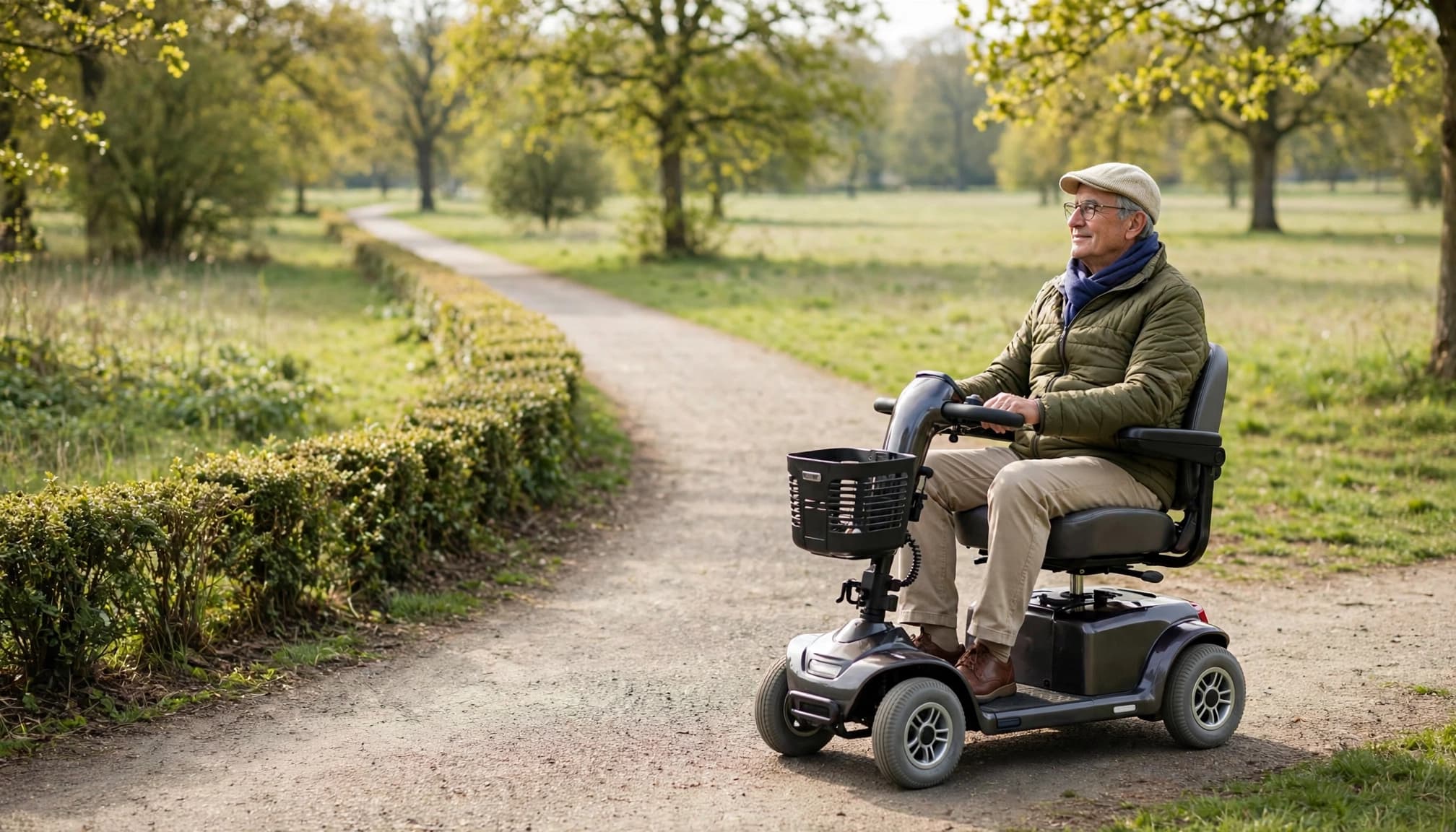
Hills, rider weight, cold weather, battery capacity and battery condition can reduce range. Allow a comfortable reserve for your return journey.
Choosing equipment and understanding aftercare
At Mobility World, we're an award-winning dealer offering advice, assessments and aftercare. Our Motability scooter and powerchair options include the Kymco Agility scooter and Rascal Rio powerchair.
Use the assessment to test everyday practicality
A home assessment is required before delivery to check that your equipment can be stored safely and securely. Your dealer also arranges test drives and places your order.
Use the demonstration and test drive to check steering, seat comfort and getting on and off. Try the access route you'll use every day. Choosing solely by advertised mileage can leave you with equipment that's hard to store or uncomfortable to use.

Consider seating needs and ongoing servicing
Powered wheelchairs may suit you better if you need to remain seated for most of the day or struggle with transfers.
The Scheme's all-inclusive lease package covers insurance, regular servicing, routine repairs and Motability Assist breakdown cover.
Our scooter servicing includes a 74-point inspection of batteries, connections, tyres, brakes and steering, plus a road test. Mileage alone doesn't reveal a scooter's condition.
Local support around Harrow and Letchworth
Nearby areas within at least a 10-mile radius of Mobility World Harrow include Pinner, Wembley and Ruislip.
Communities within at least a 35-mile radius of Mobility World Letchworth include Hitchin, Stevenage, Bedford and Cambridge. At either showroom, you can compare equipment and discuss your needs. Consider the surfaces, gradients and kerbs on your usual routes when choosing a scooter.
To talk about leasing or arrange an assessment within our home assessment areas, Contact Us.
Frequently asked questions
What's considered high mileage for a mobility scooter?
There's no universal threshold. Battery performance, maintenance history and mechanical condition matter more than one mileage figure. A well-maintained scooter's suitability depends on its condition and your needs.
Can you make a 4mph mobility scooter faster?
Don't modify a leased scooter to increase its speed. A pavement scooter must remain within its legal classification. Choose an appropriate Class 3 model if road travel suits your needs and abilities.
What's the legal age to use a mobility scooter?
Under the UK mobility scooter rules, you must be at least 14 to drive a Class 3 scooter. Class 2 scooters have no minimum age. Users must meet the relevant eligibility rules for using mobility equipment.
Do I need to track a scooter's remaining lease miles?
No. There isn't a car-style mileage allowance to count down. Instead, monitor battery charge and plan journeys within your scooter's practical range.
Focus on usable range, comfort and support
Motability scooter mileage limits shouldn't be confused with car lease allowances. For scooter users, usable battery range is the distance that matters when planning outings.
Choose equipment that fits your journeys and seating needs. A home assessment, test drive and regular servicing help make that choice practical for everyday life.


