
Compare Motability scooter specifications against your usual journeys, lifting ability and available space before focusing on speed or advertised range. The right scooter needs to fit your daily routine, including the return journey, storage and charging.
Specification sheets can be confusing because manufacturers don't always measure weight, range or turning space consistently. Start with where you'll travel, then compare what each figure means in practice.
Key takeaways before you compare
- Choose the legal class for your routes, then compare comfort, range and handling.
- Measure access and storage spaces, and distinguish total scooter weight from the heaviest lifting section.
- Use a demonstration to assess controls and comfort. Headline specifications cannot show how easily you can steer, transfer or load a scooter.
Choose Class 2 or Class 3 for your routes
Class describes legal capabilities, rather than comfort or portability. Under the government's mobility scooter classifications, Class 2 scooters have a maximum speed of 4mph. They're intended for pavements, pedestrian areas and separated cycle tracks, rather than ordinary road journeys.
Class 3 scooters can travel at up to 8mph on roads, but must stay within 4mph on pavements. They can also use separated cycle tracks, although cycle lanes are different and aren't permitted.
Class 3 scooters must be registered with the DVLA. For road use, they need effective brakes, lights, reflectors, indicators, a rear-view mirror and a horn.
Choose Class 3 because your routes require its capabilities. Before using it on roads, confirm it's road-legal and meets the relevant class and equipment rules. A higher maximum speed won't help with a narrow hallway or make a scooter easier to lift.
Compare battery range and charging needs
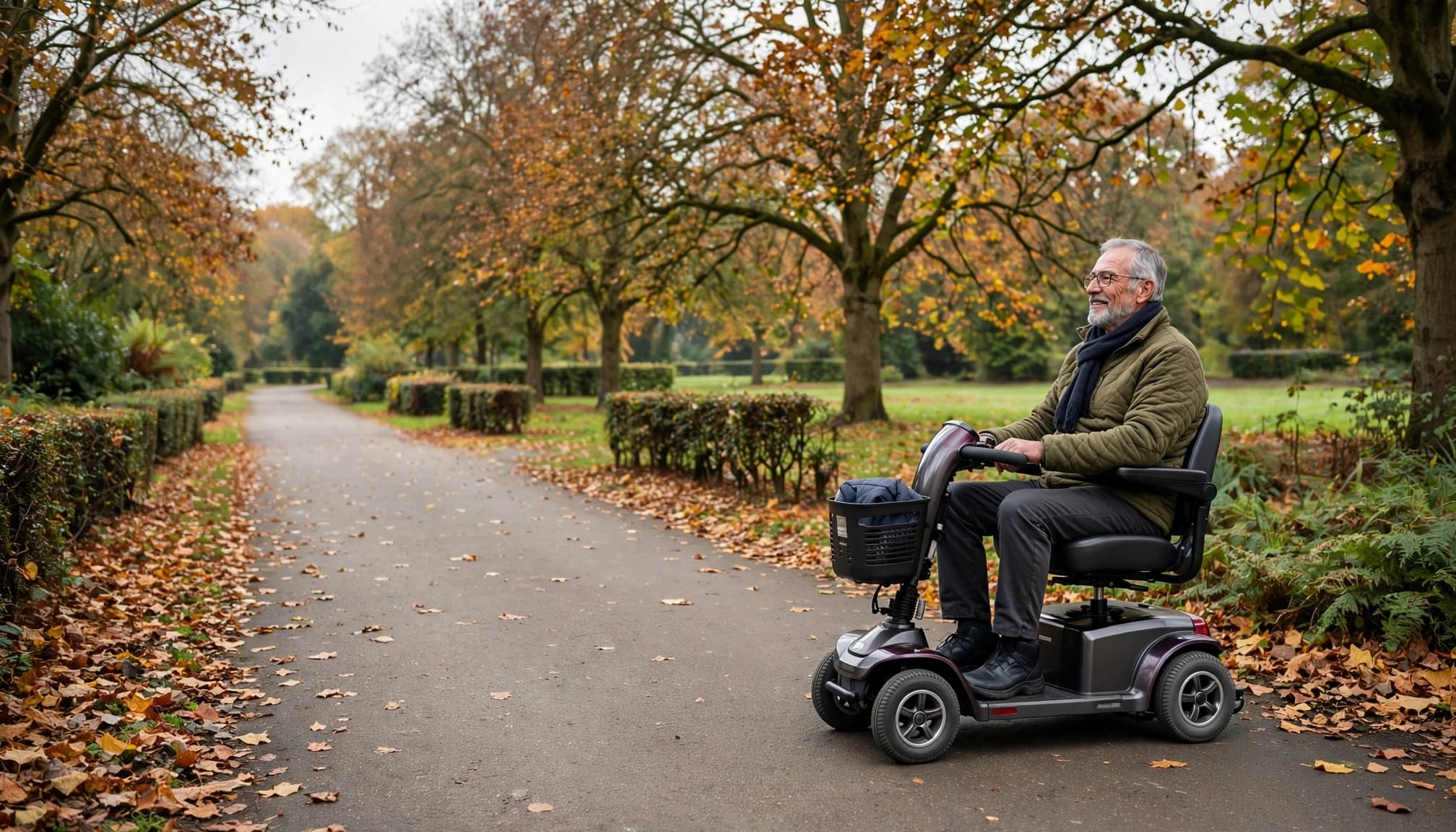
Treat advertised range as a comparison figure
A manufacturer's range figure comes from testing conditions, not a promise for every journey. Hills, cold temperatures, grass or gravel, low tyre pressure and frequent stopping can reduce it. Extra rider or luggage weight and battery age also matter.
Calculate your longest regular return journey, including diversions, rather than the distance to your destination alone. Then choose sufficient spare capacity for your conditions. There's no reliable percentage deduction that works for every scooter and route.
Understand battery type and amp-hours
A lithium-ion battery can suit folding and lightweight scooters because it provides useful capacity at lower weight. Sealed lead-acid batteries are common in larger scooters, but are heavier.
Amp-hours (Ah) describe battery capacity. However, comparing Ah alone can mislead when battery voltages differ. Watt-hours (Wh), calculated as volts multiplied by amp-hours, give a better energy comparison.
Check whether the removable battery is easy to lift out and whether you can reach a suitable charging position. A light scooter with an awkward battery compartment can still be difficult to manage.
Check lifting weight, dimensions and turning space
Separate total weight from lifting weight
A scooter's published weight may exclude its batteries, seat or accessories. For a dismantling scooter, the heaviest removable section often matters more than its overall weight.
For a folding scooter, check whether folding reduces its size only or whether parts detach to reduce lifting weight. You or your carer must manage the actual load at boot height, not just lift it a few centimetres from the floor.
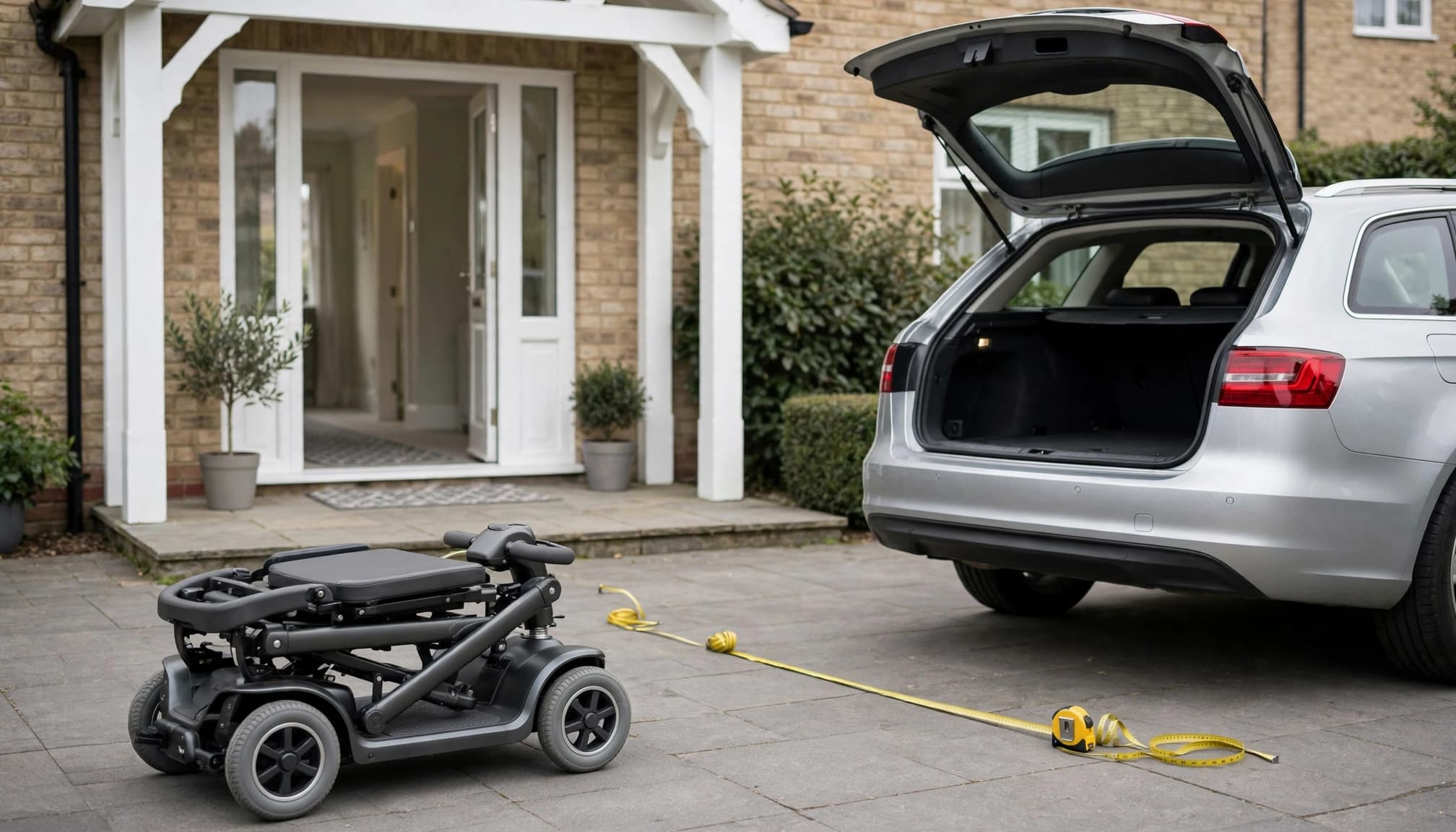
Measure the complete route into storage
Measure doorways, hallways, corners, lift dimensions and the storage position. For car transport, measure the car boot opening, loading lip and usable internal space.
Three-wheel scooters often turn more tightly, whilst four-wheel models are commonly chosen for outdoor stability. Manufacturers may quote turning radius, turning circle or differently measured turning space.
A quoted turning radius and turning diameter aren't interchangeable: diameter is twice the radius when both use the same measurement method.
Use these figures as a guide, then try the actual manoeuvre. Overall width alone won't tell you whether a scooter can turn through your hallway.
Match tyres, suspension and clearance to the ground
Balance tyre maintenance against cushioning
Solid tyres can't lose air through a conventional puncture and need little maintenance. However, they usually transmit more vibration than pneumatic tyres.
Pneumatic tyres provide more cushioning and grip, but need pressure checks and can puncture. For uneven outdoor surfaces, assess tyres and suspension together rather than treating either feature as a complete answer.
Suspension can improve comfort, but it doesn't remove the risk of tipping or make every kerb safe. Wheel size, loading and the manufacturer's stated limits still matter. Check how the suspension performs on surfaces similar to those on your regular routes.
Read gradients and ground clearance carefully
Ground clearance is the space beneath the scooter's lowest relevant point. Greater ground clearance can help on uneven surfaces, but it isn't the same as maximum kerb-climbing height.
Manufacturers express the maximum gradient in degrees or percentages. These aren't interchangeable: a 10% gradient rises 1 metre over 10 metres horizontally.
A maximum gradient normally describes a controlled testing limit, rather than a recommended everyday slope. Cross-slopes, wet surfaces, turns and uneven ground introduce additional risks.
Think about the surfaces, slopes and transitions on your regular routes. Where it's safe, test the scooter on similar ground and check how its suspension responds. Compare ground clearance with the obstacles you encounter, but remember that manufacturer limits don't guarantee suitability on every surface.
Treat "all-terrain" as a description that needs supporting specifications, rather than permission to use any surface.
Understand brakes, controls and weight capacity
An electromagnetic brake slows and stops the scooter when you release the drive control. It also helps prevent rolling when parked.
Freewheel mode disengages the motor so someone can push the scooter. Because this can disengage normal braking, never leave it unattended on a slope. Class 3 models must also meet the government's road-use equipment requirements.
Next, assess the tiller, which holds the steering and controls. You need to reach it comfortably, steer without strain and operate the drive control reliably. Seat adjustment and legroom deserve as much attention as speed.
Finally, check the manufacturer's maximum user weight and whether the weight capacity covers the rider alone or the complete load. Include shopping, luggage and accessories when assessing total load. Added weight affects range, braking and hill climbing, even when the scooter remains within its weight capacity.
Two real scooters show the specification trade-offs
These published figures highlight different priorities for everyday journeys.
| Model | Published specifications | What deserves attention |
|---|---|---|
| GoGo Carbon Ultra Lite | 13.7kg without batteries; 4mph; advertised 15-mile (24km) range; capacity up to 120kg. | The quoted weight excludes batteries, so check the total lifting weight and battery arrangement. |
| Kymco AGILITY | 8mph; 5.4-inch ground clearance, approximately 137mm; oil-dampened suspension. | Check outdoor comfort, storage space and transport requirements. |
Before choosing either model, check its dimensions, turning space and charging arrangements against your home and travel routine. The figures above don't include those details.
The AGILITY's listed purchase price is £3,329 including VAT. That's a retail purchase figure, not a Motability lease quotation.
Neither design suits every routine. Portability may matter more for car journeys, while suspension and clearance may matter more on uneven local routes.
For leasing choices, browse our Motability scooter and powerchair leasing scheme. Compare available products with your requirements, as retail models may not have identical Scheme availability or terms.
Use a home assessment to test everyday suitability
Let your own experience guide the decision
Mobility World is an award-winning dealer, and we recommend testing the tasks you'll repeat most often. Our free home assessments, within our home assessment areas, help you judge suitability where you'll use the scooter. Staff can consider your actual storage space and local route conditions.
During a demonstration, try sitting comfortably, reaching the controls and turning in your available space. Include transferring on and off, using the storage position and handling removable parts.
Bring your experience of any previous scooter, including discomfort or difficult manoeuvres. Your own first-hand observations are more useful than choosing solely by someone else's recommendation.
Include servicing and local support
Under the Motability Scheme, insurance, servicing, maintenance and breakdown cover form part of the leasing package. Compare suitability alongside the payment, because included maintenance cannot correct an unsuitable seating position.
Our servicing includes a 74-point inspection covering batteries and connections, tyres, brakes, steering adjustments and a road test. These are also useful areas to understand during handover.
We welcome enquiries within a 10-mile radius of Mobility World Harrow, including Pinner, Stanmore and Wembley. Around Mobility World Letchworth, our 35-mile radius includes Hitchin, Stevenage, Luton, Bedford and Cambridge.
To discuss a showroom demonstration or home assessment, Contact Us with your journey and storage requirements.
Frequently asked questions
How much does a mobility scooter weigh?
There's no single useful average across folding, dismantling and road-going scooters. The GoGo Carbon Ultra Lite's 13.7kg figure excludes batteries, illustrating why the weight definition matters. Compare complete operating weight and the heaviest component you'll lift, including any parts you cannot remove independently.
What is a good turning circle for a small home?
A suitable turning circle is one that permits the complete manoeuvre in your space. There's no universal figure because doorway positions and hallway angles differ. Compare measurements taken on the same basis, then demonstrate the turn without moving furniture you need to keep in place.
Do I need DVLA registration or vehicle tax?
Class 2 scooters don't require DVLA registration. Class 3 scooters do, but no vehicle tax is payable when registered as a mobility scooter. The official registration and vehicle tax guidance explains the distinction. Registration requirements don't disappear if you intend to use a Class 3 scooter mainly on pavements.
Are lithium batteries always the better choice?
Lithium's lower weight can be helpful when carrying batteries indoors or transporting a scooter. However, suitability also depends on charging arrangements, capacity and compatibility with the scooter. Use only the battery and charger arrangements approved for that model; battery chemistry alone doesn't determine practical range.
Choose the scooter that fits your routine
The most useful Motability scooter specifications are those you can connect to a real journey or task. Prioritise usable range, manageable weight and comfortable control over the largest headline figures.
Measure your spaces, compare specifications on equal terms and use a demonstration to assess the fit. A suitable scooter should work for the journey, the return home and everything needed to store and charge it.


