
Power wheelchairs need to work at your kitchen doorway as well as on your usual outdoor journey. Choosing a layout is only one part of finding a suitable chair; the complete chair must fit your body, home and daily routine.
Rear-wheel drive and mid-wheel drive describe where the powered wheels sit, but neither drive configuration guarantees particular performance. Start with the tasks you need to manage, then compare suitable chairs through a home assessment and supervised trial.
Key takeaways before you choose
- Compare individual models, because wheel position alone doesn't establish turning ability, comfort or outdoor suitability.
- Test the chair in your actual home, with its prescribed seating and footplates fitted.
- Check tyre requirements, servicing, transport arrangements and lease costs before committing.
Your first-hand experience should guide the decision alongside professional advice. A specification sheet can help you shortlist chairs, but it can't show whether you feel comfortable using one throughout your day.
Comparing powerchair drive wheels by layout
The powered wheels receive power from the motors. Caster wheels are the smaller, freely swivelling wheels that support the chair.
These basic distinctions help you identify the wheelchair wheels in each layout.
| Layout | Drive-wheel position | What to examine during a trial |
|---|---|---|
| Rear-wheel drive | Towards the back of the chair | Forward turns, reversing and clearance around footplates |
| Mid-wheel drive | Around the middle of the chair | Complete turning footprint, castor movement and threshold handling |
| Front-wheel drive | Towards the front of the chair | Rear clearance, steering response and approaches to obstacles |
Neither rear-wheel drive nor mid-wheel drive guarantees a particular level of turning, stability or performance on different surfaces. The complete drive configuration and exact model matter.
With rear-wheel drive, check how wheel size and suspension geometry affect clearance and grip. Mid-wheel drive models may behave differently, depending on their design.
Some rear-wheel drive chairs use a hub motor, while a mid-wheel drive model may use one too. Motor placement and frame engineering vary by model.
Treat the final column as observation points, not promised strengths or weaknesses. Manufacturers can use different frames, wheel arrangements and suspension systems within the same drive category.
Ask for the exact model's width, length and stated turning measurement. Check whether figures include footplates, headrests and other fitted accessories.
Compare the stated turning radius only with measurements for the same model. Also clarify whether a published figure describes a turning radius or turning diameter. These aren't interchangeable, so comparisons can become misleading.
The practical recommendation is to shortlist complete chairs that meet your needs, then compare each model's maneuverability during everyday movements, including mid-wheel drive options. Avoid ruling out an entire layout before trying an appropriate model.
Match the chair to your home and outdoor routes
Indoor space means more than doorway width
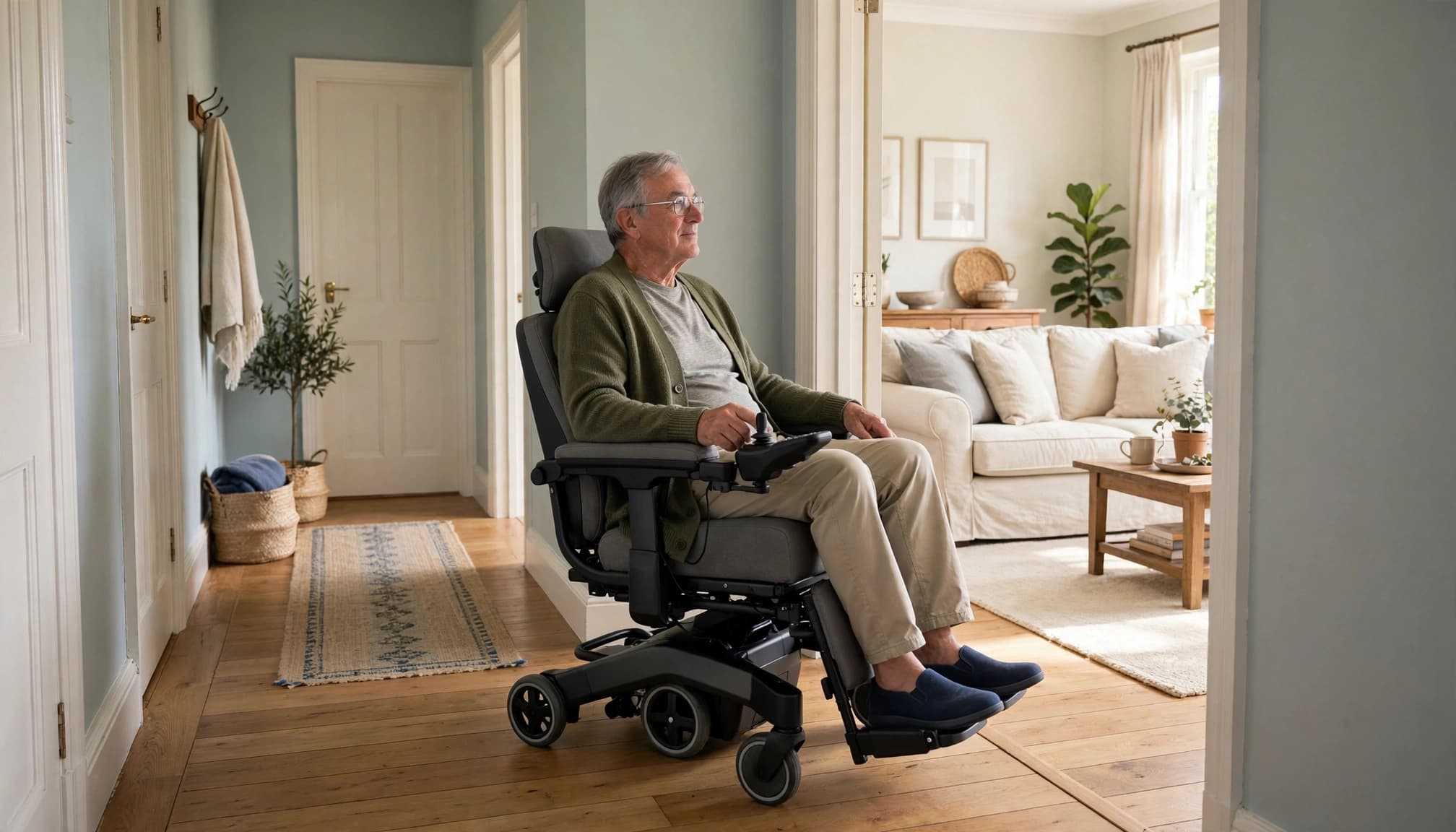
Measure the narrowest doorway, but also check the approach and exit space. You may need to turn beside a radiator or cupboard.
During a trial, approach your dining table and turn beside your bed. Test reversing too, as leaving a room can feel different from entering it.
Check clearance around your feet and elbows, not just the wheels. The frame, castors and powered wheels can all affect manoeuvring, so ask the assessor to watch any movements you find difficult.
Also check where you'll park and charge the chair. Your route needs a reachable socket and enough space to keep household exits clear.
Outdoor suitability needs model-specific evidence
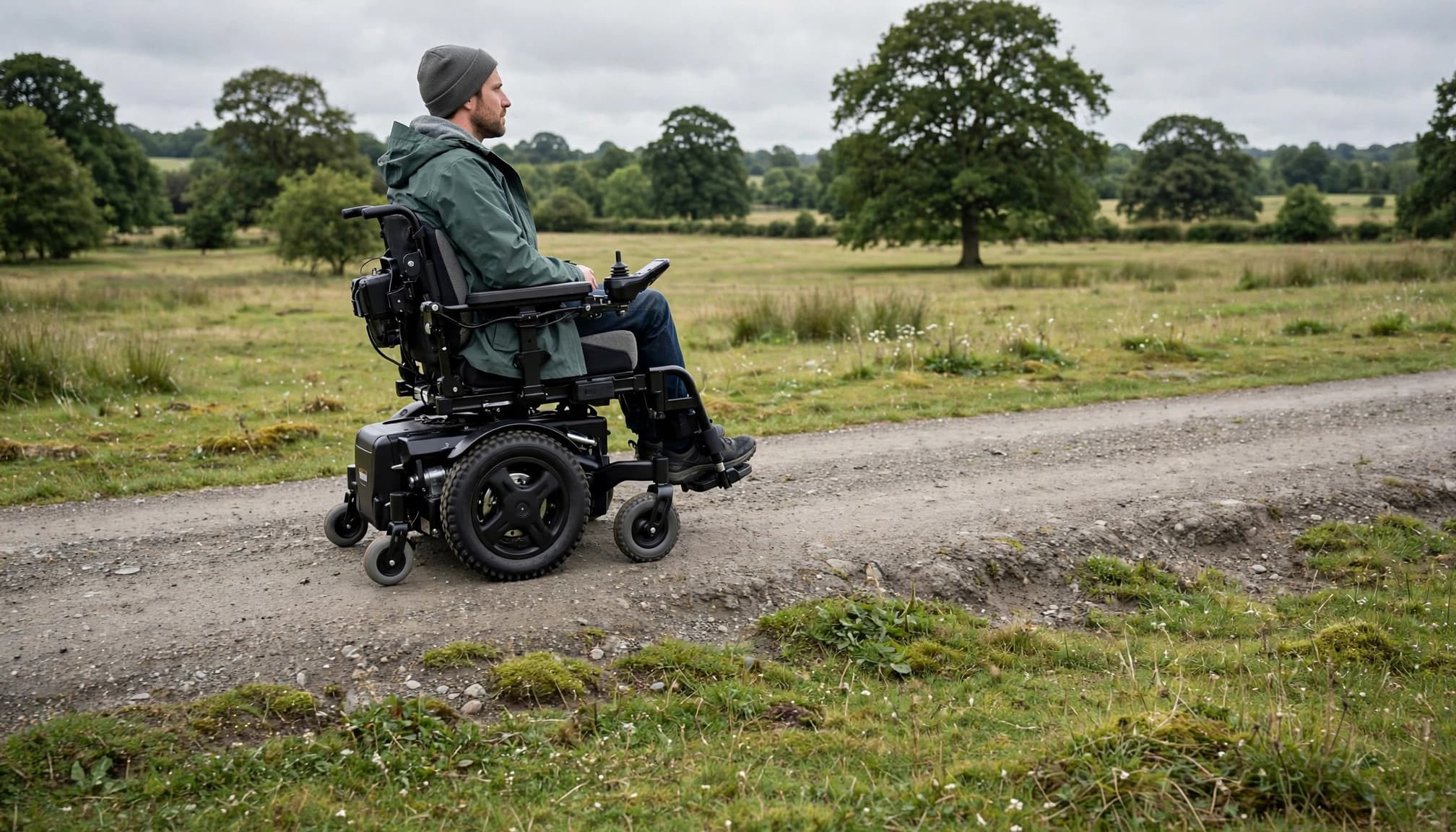
Describe your usual outdoor terrain accurately: paving slabs, dropped kerbs, firm paths or uneven grass. Each surface places different demands on a chair.
Ask for the manufacturer's permitted gradients, obstacle limits and approved operating conditions. Mid-wheel drive and rear-wheel drive models can behave differently, but neither layout guarantees suitability for a particular surface.
The frame, castors and suspension affect how a chair handles bumps and its shock absorption. The label all-terrain wheels doesn't prove a powerchair is safe or suitable on every surface, so check its traction and stability limits.
Test relevant surfaces only if the assessor confirms it's safe. Observe steering effort, stopping and your seated comfort.
Tell the adviser about your return journey too. Distance, slopes and charging arrangements all belong in the assessment. A mid-wheel drive chair on smooth showroom flooring can't establish suitability for your local route.
Check tyres, castors and servicing together
Compare tyre options on the actual chair
Don't choose tyres separately from the chair's approved specification. Ask which solid tyres or pneumatic tyres the manufacturer permits for that model.
For pneumatic tyres, request the specified pressure and checking instructions. For solid tyres, ask about inspection, wear limits and replacement arrangements.
Ask the adviser to explain how each approved option suits your intended use, using manufacturer information. Don't assume one material automatically provides better traction or comfort.
Ask how the size and position of the powered wheels and smaller castors work with that chair's frame, seating and suspension. Confirm whether the specific model has a hub motor.
Plan maintenance before a problem develops
A useful servicing discussion covers tyre condition, wheel security, castor movement, the battery and motor, and the braking system. Ask which checks you can perform and which need an engineer.
Report new noises, unexpected steering behaviour or changes in stopping promptly. Don't compensate by changing settings or fitting unapproved parts.
For leased equipment, Motability's powered wheelchair maintenance guidance confirms that routine servicing and maintenance form part of its full lease package.
However, included maintenance doesn't replace daily care. Get the model's instructions and ask how to arrange repairs, recovery and support if the chair becomes unusable.
Use a home assessment to test everyday tasks

Ask for advice that starts with your needs
Motability's Jim Wood, Relations Manager for scooters and powered wheelchairs, emphasises understanding your requirements through a visit to your home. Its powered wheelchair assessment information confirms a home assessment and the chance to try different power wheelchairs.
Explain any pain, fatigue, posture concerns or changes in hand movement. A family member or carer can help describe tasks, but your experience should remain central.
Ask the adviser to explain how the complete chair, including its fitted seating and powered wheels, meets your needs. When comparing rear-wheel drive and mid-wheel drive, describe how each chair behaves during the tasks that matter to you. Ask the adviser to confirm details for the exact chair, including its braking system and, if relevant, whether it has a hub motor.
Record what you notice, not just what feels familiar
Use the same everyday tasks when comparing chairs. Note whether you can reach the controls, position yourself at furniture and stop comfortably.
If fatigue develops over time, request enough trial time to assess it. Tell the adviser immediately about discomfort or difficulty.
Test with the seating and footplate arrangement you intend to use. A different configuration can change both your comfort and the space the chair occupies.
A common selection mistake is choosing after one short drive. Another is letting someone else's preferred steering feel outweigh your own experience. Record your observations before discussing the final choice.
Buying or leasing: understand the support package
If you're considering the Motability scooter and powerchair leasing scheme, compare products once you've established your seating and driving requirements. A powerchair differs from a manual wheelchair with power assist, so check whether an add-on is compatible during an assessment.
Mobility scooters are also worth considering when appropriate. Their tiller controls and seating arrangements need a separate assessment of your reach, strength and posture.
Motability's questions to ask before choosing explain that leases typically provide a replacement product every three years. Complex powerchair arrangements can differ, so confirm the applicable term.
Ask for the quoted weekly payment, any upfront payment and details of the support included. Don't assume every product has the same costs or arrangements.
An NHS assessment is another route to explore. The NHS explains how a GP, physiotherapist, occupational therapist or hospital team can refer you for a local wheelchair service assessment.
Before ordering, check the requirements for transporting the chair in a vehicle. If you intend to remain seated during travel, ask about its approved transport arrangements.
Local advice around Harrow and Letchworth
Award-winning dealer Mobility World offers advice through its Harrow and Letchworth showrooms. Ask which powerchair models are available for demonstrations before travelling.
For readers within a 10-mile radius of Harrow, nearby areas include Pinner, Stanmore, Wembley, Ruislip, Northwood and Watford. Mobility World Harrow can help you discuss your requirements and confirm assessment arrangements.
For readers within a 35-mile radius of Letchworth, surrounding areas include Hitchin, Baldock, Stevenage, Royston, Welwyn Garden City, St Albans, Bedford, Cambridge and Milton Keynes. Mobility World Letchworth can advise on suitable next steps.
These distances help you identify your nearer branch; confirm home-visit availability for your postcode rather than assuming automatic coverage.
Call Harrow on 020 3958 4328 or Letchworth on 01462 418478. You can also Contact Us to discuss a demonstration.
Have your doorway measurements, usual journey details and transport requirements ready. They give the adviser a useful starting point before recommending products.
Frequently asked questions
Which powerchair layout is best for a small home?
Compare the full turning footprint of suitable models, rather than choosing by drive layout alone. Mid-wheel drive can offer a compact turning radius, while rear-wheel drive may feel different to manoeuvre; neither is best for every home. Include footplates and any prescribed seating equipment. During a home trial, test the tightest turn and approach to your bed or toilet, with the assessor checking clearances as you drive.
Can a mid-wheel-drive chair handle gravel or grass?
Check the specific model's approved surfaces, gradients and obstacle limits. Mid-wheel drive alone doesn't determine suitability for outdoor terrain. Describe whether the ground is firm, loose, wet or uneven, then request a supervised trial where appropriate. Don't test unfamiliar terrain without checking the manufacturer's guidance and the assessor's advice.
Can powered wheels be added to my manual wheelchair?
Some systems provide power assistance, but fitting depends on the exact wheelchair and add-on combination. Ask suppliers to confirm frame compatibility, mounting requirements, loading limits and braking arrangements. Consider controls, transport and servicing too. Don't assume motorised wheels will fit any standard manual frame.
How do I apply for a Motability powerchair?
An approved dealer can help eligible customers apply after assessment and product selection. Ask them to check your qualifying mobility allowance, remaining award period and proposed lease terms. Arrange demonstrations before ordering, so the application follows a suitable choice rather than the leasing process determining the chair.
Choose the chair you can use confidently
The right layout is the one within a complete powerchair that meets your assessed needs. Wheel position is a starting point; your everyday experience should guide the final choice.
Compare suitable models at home, check their approved outdoor use and agree servicing arrangements before committing. A chair that works comfortably at your kitchen doorway deserves as much attention as one that handles your journey outdoors.


