


Mobility World guide • UK rules • Indoor mobility scooters & powerchairs • Trading since 1990 • Harrow & Letchworth showrooms
Indoor Mobility Scooter or Powerchair? How to Choose the Right Fit for Your Home
The Quick Answer: The best indoor mobility scooter or powerchair is the one that fits your doorways, turning space and seating needs — not just its product class. A compact Class 2 mobility scooter suits hallways and pavement trips at up to 4 mph, while a powerchair often gives a tighter turning circle and better postural support indoors. Mobility World's Harrow and Letchworth teams offer home assessments so you can test the exact model against your own doors, thresholds and daily routes before you decide.
A vehicle that catches on the lounge doorway soon becomes more frustrating than helpful. An indoor mobility scooter should suit your doorway widths, posture, controls, charging needs and routine. It must fit real life, rather than simply match a product class.
A lightweight mobility scooter, folding mobility scooter, portable mobility scooter or travel mobility scooter can simplify transport. However, portability may reduce seating support or outdoor capability. Check battery range, charging access and whether a lithium battery suits your routine. Full suspension can add weight and bulk, so it isn't automatically useful for indoor-only driving. A compact design may matter more in a lounge or narrow hall.
A mobility scooter that works well for local trips may still feel cumbersome beside a dining table. For daily errands, second-hand mobility scooters can be an option, but check the battery, brakes and overall condition. A powerchair can be easier indoors, but it also needs suitable seating, controls and footprint.
Mobility World, an award-winning mobility dealer, helps customers compare a mobility scooter with a powerchair through practical demonstrations and home assessments.
Indoor mobility scooter or powerchair: match it to daily life
Start with the journeys you make most often. That may be from the bedroom to the bathroom, around kitchen cupboards, or through a hallway with doors on both sides.
A compact mobility scooter suits people who want a familiar tiller, occasional indoor use and useful outdoor range. A travel mobility scooter may suit occasional indoor journeys, while a powerchair may be preferable for joystick control, postural support or tighter turns. Steering a mobility scooter requires reaching forward and maintaining an upright position.
The table compares a mobility scooter and powerchair across the practical points that matter indoors.
| Consideration | Compact mobility scooter | Indoor-oriented powerchair |
|---|---|---|
| Controls | Uses a tiller, so arms must comfortably reach forward | Uses a joystick or alternative control position |
| Turning space | Usually needs a wider sweeping turning circle | Mid-wheel models may turn more closely in confined rooms |
| Seating | Often has a swivel seat for easier transfers | Can offer more postural support and individual adjustments |
| Transport | Many travel models fold or dismantle for transport, and a compact design can ease storage. A lithium battery may affect airline transport, so check operator rules | Some models need a suitable vehicle or hoist. A lithium battery may have separate transport requirements |
| Outdoor use | Often practical for pavements and short trips, with pneumatic tyres and useful battery range. Full suspension may improve comfort, but can increase weight and footprint | Depends on the model, tyres and battery range |
No type is automatically better. Test the tightest route with a shopping basket if you use one, and check for a comfortable tight turning circle. The exact model must clear the route and remain comfortable after more than a few minutes.
Measure your home before choosing
A brochure width is only a starting point. For an indoor mobility scooter, measure the clear household space after doors, handles, furniture and radiators are included.
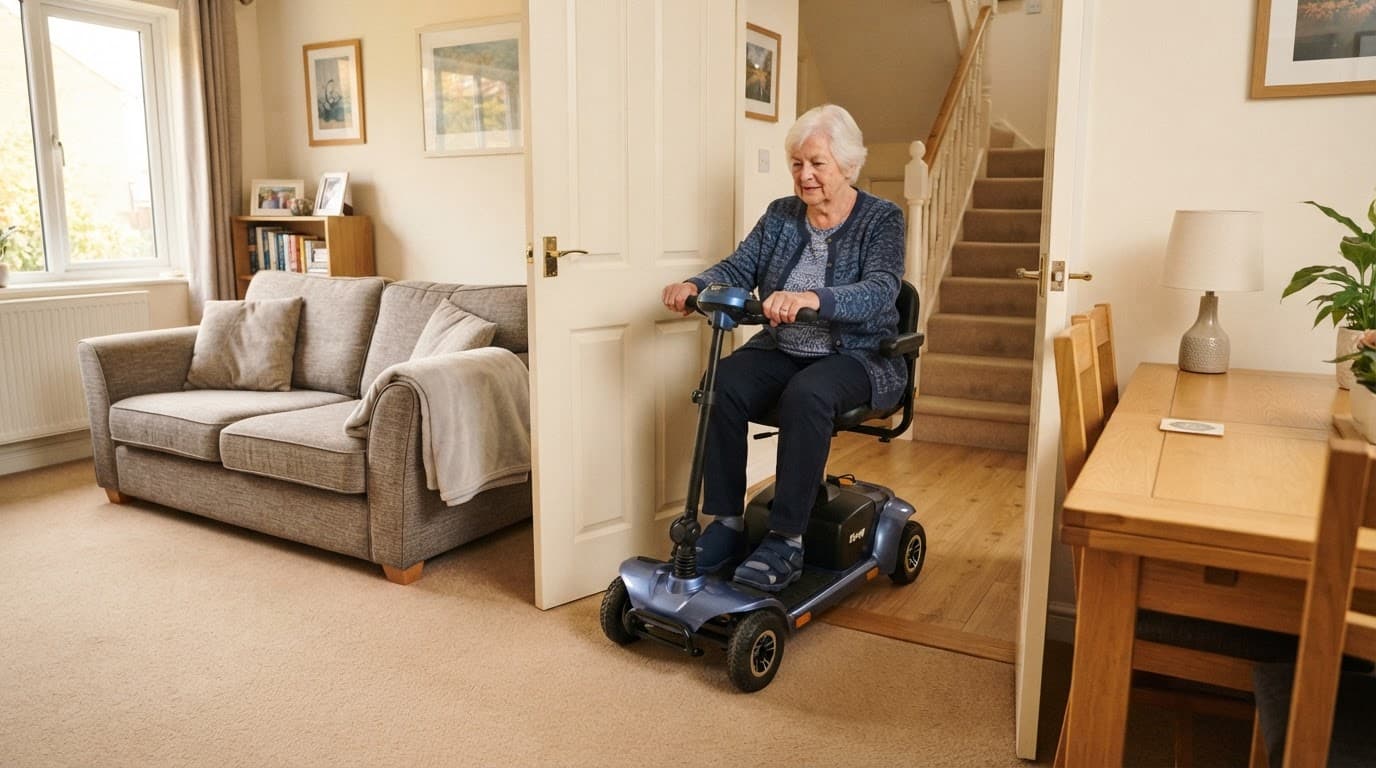
Check doorways, corridors and turns
Measure the narrowest clear gap in every doorway, with the door fully open. Then compare it with the mobility scooter's overall width, including armrests, mirrors and any side guards.
Also measure corridor width and the space immediately after each doorway. A mobility scooter may pass through a 76 cm opening but fail to make the turn into a compact bathroom. Check its turning circle against this space. Door thresholds, thick carpet, changes in floor level and ground clearance deserve the same attention.
The tightest route through the home matters more than the largest room. Measure the turn after each doorway, not only the doorway itself.
Follow the route you will actually use
Walk the route at the time you normally use it. A hall that looks clear at midday may have shoes, laundry baskets or a walking frame in it later.
Marking the product's length and width on the floor with masking tape can help families picture the space. It shows whether the vehicle can manoeuvre to a dining chair, get close enough to a worktop, or park beside a bed without blocking a transfer.
Features that make indoor driving calmer
An indoor mobility scooter, like any mobility scooter used at home, needs manoeuvrability, accessible controls and a stable seating position.
Battery range matters more outside, and a lithium battery may help with longer trips. Indoors, battery range should not outweigh access, while a lithium battery still needs a suitable charging point.
Give cornering room more weight than headline range
A published turning circle helps, but test it in a real corner. A tight turning circle on paper may feel different beside a doorway or furniture edge.
Even a compact design needs enough room for the user’s knees, feet and any shopping bag or oxygen equipment.
Five-wheel layouts can offer responsive steering on some models, with added stability through the centre of the chassis. Still, five wheels don't guarantee a tighter turn. Check the model's overall length and published cornering figures before deciding.
On a mobility scooter, solid tyres can avoid punctures on clean indoor floors, but may feel firmer over thresholds. Pneumatic tyres may feel more comfortable on uneven paths, although they need pressure checks and maintenance.
Solid tyres are not ideal for every floor, and pneumatic tyres are not ideal for every outdoor route. Compare comfort, grip and noise during a trial.
Full suspension can soften jolts on uneven outdoor paths and improve ride comfort. It may also help with floor transitions, although results depend on the surface. The added weight of full suspension can make lifting and transport harder.
Outside, full suspension may improve stability on rougher routes. Indoors, full suspension can increase the vehicle's footprint and affect access through narrow spaces. Ask whether full suspension suits the available floors and storage space.
Test seating and controls for at least 20 minutes
A swivel seat can make transfers easier, provided it locks securely before moving. Adjustable armrests, seat height and an adjustable tiller can reduce strain on shoulders and hips. Also check whether anti-tip wheels clear thresholds without catching.
For a mobility scooter, assess whether the user can grip and turn the tiller without pain or fatigue. For a powerchair, test the joystick with the preferred hand and check access to tables, kitchen units and washbasins.
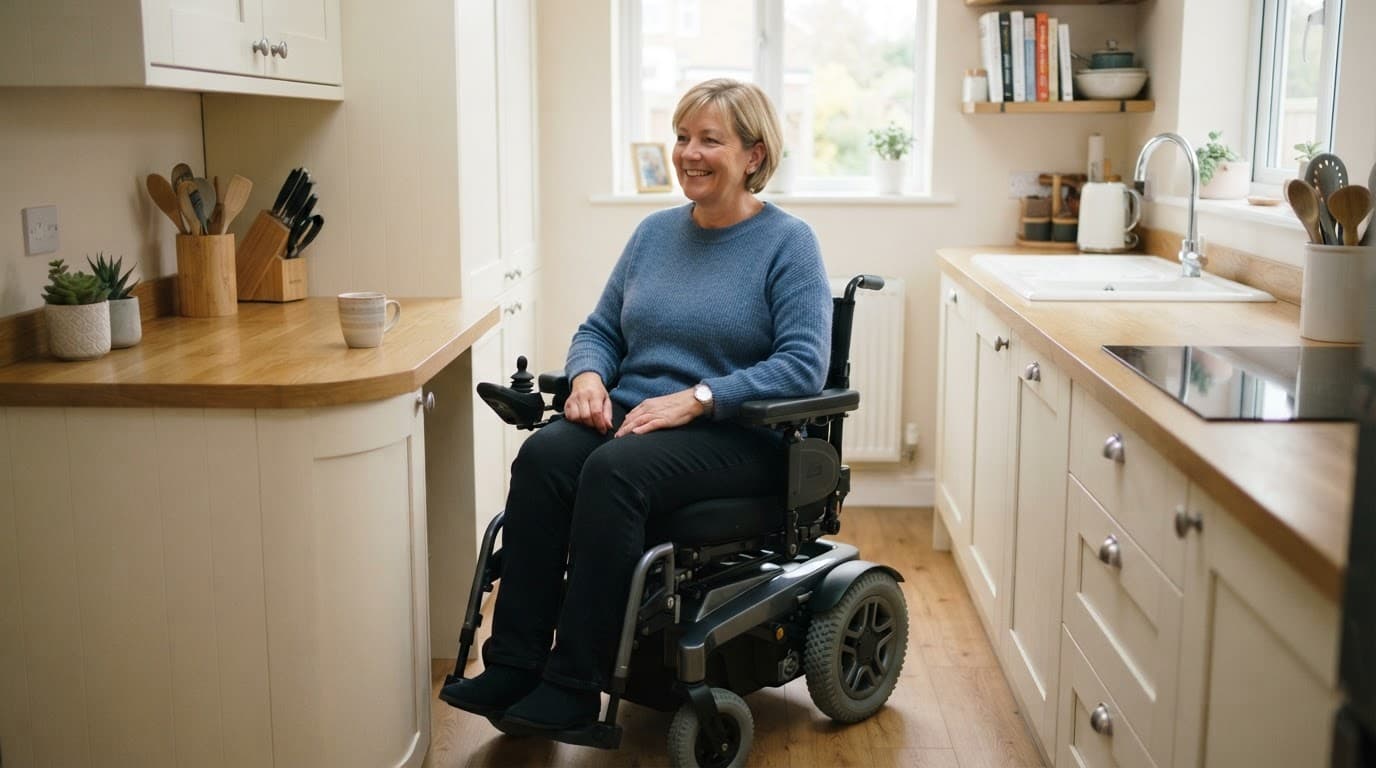
Families often ask about slopes, kerbs and public transport too. Those needs may point towards a different model than the one that feels best in the living room, so a balanced trial matters.
Class 2 mobility scooters and Class 3 mobility scooters for indoor and outdoor use
Most people choosing a home-friendly mobility scooter will first consider Class 2 models. These are designed as pavement mobility scooters, with a maximum speed of 4 mph. Full suspension is optional, and suspension, tyre type and battery chemistry don't determine the legal class of a mobility scooter. Pneumatic tyres and solid tyres may suit different outdoor surfaces, while a lithium battery can affect transport or charging arrangements. Short pavement trips may need less battery range than longer outdoor journeys.
Class 3 mobility scooters have a maximum speed of 8 mph on roads and may be used there when appropriate. They are usually larger, heavier and less convenient around tight furniture. Full suspension may improve comfort on uneven ground, but it isn't required for Class 3. They may be road legal only when the relevant legal conditions are met, and must also be registered with the DVLA. Read the current GOV.UK vehicle class rules before using either type outside.
Pavements and shopping centres have different rules
Class 2 and Class 3 vehicles may use pavements and other pedestrian areas, although both must travel at no more than 4 mph there. They cannot use cycle lanes. GOV.UK sets out the rules for footpaths, pavements and parking.
Shopping centres, supermarkets and hospitals may set their own conditions because they manage private premises. Ask staff before entering, keep to walking pace and give pedestrians plenty of room.
Avoid buying for a journey you rarely make
A long battery range and full suspension may be valuable for country paths or lengthy errands. Full suspension can add weight and may affect transport, so test the vehicle rather than assuming it will help. Check ground clearance separately for kerbs and thresholds.
Yet those features can add bulk to a vehicle intended mainly for an accessible flat. Full suspension may reduce indoor agility, and extra battery range can be excessive for an occasional route.
Some buyers may qualify for vat relief, based on their eligibility and intended use rather than the vehicle's class. Check whether vat relief applies before choosing a model. Available vat relief won't make an unsuitable vehicle practical.
Choose a Class 3 mobility scooter when its road capability and outdoor stability match regular use, and test full suspension before deciding. Choose a compact Class 2 model or powerchair when home access comes first. A mobility scooter that fits daily routes and rooms is usually a better choice than one bought for a rare journey.
Home assessments prevent costly mistakes
A showroom trial tells you how a mobility scooter feels. A home assessment shows whether it works beside your own sofa, through your own doors and over your usual thresholds.
Ask for a realistic demonstration
During a visit, ask the assessor to test the narrowest doorway, your parking space and the bathroom route. They should check access to the charging point, the transfer position and whether the user can operate the controls confidently, including the adjustable tiller.
Test the outdoor route as well, noting slopes, uneven ground and thresholds where full suspension may improve comfort. Ask how full suspension affects the vehicle's weight and servicing needs before choosing it. Relate the route to daily errands, including shopping, access to transport and the return journey.
Transport and storage also deserve attention. A folding mobility scooter may help with storage, while a portable mobility scooter may suit car travel, but neither option replaces a home check. A lithium battery can make lifting and transport easier, but ask how charging affects battery range. If the battery is removable, check whether a second lithium battery is practical and safe to store.
Anyone considering second-hand mobility scooters should obtain a condition and safety check before purchase, even if the vehicle seems suitable at home.
Mobility World Letchworth offers home assessments within a 35-mile radius, reaching areas including Hitchin, Stevenage, Baldock, Welwyn Garden City, St Albans and Bedford. Mobility World Harrow covers a 10-mile radius, including Pinner, Ruislip, Wembley, Edgware and Stanmore.
People with the qualifying mobility component of personal independence payment and at least 12 months remaining may be able to exchange it for a new vehicle through Mobility World's Motability Scooter & Powerchair Leasing Scheme. This option forms part of the Motability Scheme, and eligibility depends on the qualifying mobility component and remaining award period.
Current Motability Scheme arrangements include insurance, servicing, maintenance and breakdown cover. Confirm the product's weekly Motability Scheme allowance, any advance payment and current eligibility before ordering.
Choosing the Motability Scheme may help with budgeting, but it doesn't make every vehicle suitable for your home. VAT relief is a separate purchase tax concession, not an automatic part of a lease. If buying rather than leasing, ask whether VAT relief applies to the vehicle and your circumstances. Confirm the VAT relief declaration with the retailer before ordering.
Plan for servicing, not only delivery day
Indoor use still creates wear. A mobility scooter also needs regular checks of tyres, batteries, brakes and steering, particularly when it's used outside.
Inspect pneumatic tyres for pressure, tread and punctures. Solid tyres need checks for wear, cracks and secure fitting.
Mobility World's servicing includes a 74-point inspection, covering battery connections, wheels and tyres, braking, steering adjustments and a road test. That level of checking can identify a weakening battery or brake issue before it affects a trip. To arrange advice, a showroom visit or an assessment, Contact Us.
VAT relief may reduce the purchase cost
Eligible disabled people may use VAT relief to buy certain mobility aids for personal or domestic use. You do not need to be registered disabled or receive a particular benefit.
- HMRC eligibility: You must meet HMRC's definition of being chronically sick or disabled. This determines whether VAT relief applies, and a diagnosis alone does not automatically establish eligibility.
- Vehicle design: A mobility scooter designed not to exceed 4 mph and intended for pavement use may qualify.
- Class 2 example: VAT relief may apply to an eligible Class 2 model that meets these requirements.
- Class 3 models: Rules differ for class 3 mobility scooters, so VAT relief needs separate checking with the retailer.
- Declaration and invoice: Complete the required disability declaration and ask the retailer to confirm VAT relief on the invoice.
For current guidance, read the VAT relief rules for disabled customers on GOV.UK. Check both your eligibility and the exact product before buying.
Choose the vehicle that fits your real home
The best mobility scooter for your home gives you room to move without turning every doorway into a challenge. Measure your route, test it properly and assess how your posture and control access feel during a full trial.
An indoor mobility scooter can suit a home with clear space and regular outdoor use. Consider battery range and full suspension only when outdoor journeys are routine. A powerchair may offer more control and comfort where sharp turns, posture or limited arm movement shape the day. If you choose a mobility scooter, check charging and transport arrangements for its lithium battery. Finally, check whether vat relief applies, as eligibility must be confirmed rather than assumed.
Helpful Mobility World resources
- Mobility scooters – browse all models
- Class 2 pavement mobility scooters
- Class 3 road mobility scooters
- Portable boot scooters
- Folding mobility scooters
- Approved used mobility scooters
- Motability leasing options
- Support and servicing via our Letchworth hub
- Support and servicing via our Harrow hub
- Free expert advice
- Contact us
About Mobility World
Mobility World is a UK mobility equipment specialist serving customers since 1990 through showrooms in Harrow and Letchworth Garden City.
Our team helps customers choose mobility scooters, powerchairs, adjustable beds and daily living aids through suitability assessments, home delivery, installation and ongoing servicing and repairs.
Visit our showrooms:
- Harrow showroom – 78-80 Station Road, Harrow, Middlesex HA1 2RX
- Letchworth showroom – Birds Hill, Letchworth Garden City, SG6 1HX
Customers can test equipment in store or arrange home assessments across Hertfordshire, Bedfordshire, Cambridgeshire, North London and North West London.
Why Trust Mobility World?
Since 1990, we have been far more than an online retailer. Our advice is backed by:
- Physical Showrooms: Visit us in Harrow or Letchworth for hands-on demonstrations and expert guidance.
- Trading Standards Approved: Buy with Confidence — independently verified consumer protection.
- Driving Mobility Approved: PWMS Trained and Accredited — recognised professional standards in powered wheelchair and mobility scooter assessment.
- Expert Engineers: Our own mobile engineers provide lifetime support, servicing and repairs — not third-party contractors. That means accountability and continuity of care.
- 0% Finance Available: Spread the cost with interest-free finance options on selected products.
- Price Match Promise: Found it cheaper elsewhere? We'll match it — see our Price Match Promise.
Ready to find the right indoor mobility scooter or powerchair?
Browse our range online, call us for advice, or arrange a home assessment at Harrow or Letchworth.
People also ask about indoor mobility scooters and powerchairs
What is the difference between an indoor mobility scooter and a powerchair?
A mobility scooter is steered with a tiller and usually needs a wider turning circle, while a powerchair is controlled with a joystick and can offer tighter turns and more postural support. The right choice depends on doorway widths, turning space and how the user prefers to steer.
Which mobility scooter class is best for use around the home?
Compact Class 2 pavement scooters are usually easier to manoeuvre indoors than Class 3 road scooters, which are larger and designed for longer outdoor journeys at up to 8 mph.
Do I need a home assessment before buying an indoor mobility scooter or powerchair?
A home assessment is strongly recommended. It checks doorway widths, turning space, thresholds, charging access and transfers against your actual home, rather than relying on brochure measurements alone.
Can I get VAT relief on a powerchair as well as a mobility scooter?
VAT relief can apply to both mobility scooters and powerchairs when bought for personal use by someone who meets HMRC's definition of chronically sick or disabled. Eligibility and product design should be confirmed with the retailer before ordering.
Frequently asked questions
Is a folding mobility scooter suitable for trains and aeroplanes?
Some are, but train and airline operators set their own rules on size, weight and battery type. Ask the train company before travelling and obtain airline approval before booking, particularly where a lithium battery is involved. Never assume a folding model will be accepted without prior notice.
Does a five-wheel scooter always turn more tightly?
No. A five-wheel design may improve steering response on some models, but dimensions still determine indoor handling. Compare the total length, width and steering response, then trial it around your own furniture.
Can I use a mobility scooter in an indoor shopping centre?
You may be able to, but centre management can apply its own access and safety rules. Keep to a slow pace, park only where permitted and ask staff if you are unfamiliar with the building.
Can I get VAT relief on any model?
VAT relief depends on the buyer's eligibility and the vehicle's design. It may apply when bought for personal use by a qualifying disabled person. Ask for the VAT relief declaration before paying.
Can the Motability Scheme provide a scooter or powerchair for home use?
Yes, eligible customers may use a qualifying mobility allowance to lease a new scooter or powered wheelchair through the Motability Scheme. Eligibility depends on receiving the relevant mobility component of Personal Independence Payment and having the required award period remaining. A home assessment still matters, because scheme availability doesn't replace checking doorways, turning space and seating comfort.
Does full suspension help indoors?
It can improve comfort over uneven surfaces, but may add weight and bulk. Check the available space and seating position, then try the vehicle at home if possible.
What should I check when buying second-hand mobility scooters?
Check the battery's age, charger, tyres, brakes and service history. Confirm ownership and arrange an inspection or trial before paying.
How should I charge and store a lithium battery?
Follow the manufacturer's instructions and use the supplied charger. Keep it dry, cool and away from heat, and don't charge it unattended. Before travelling, check how the operator wants a lithium battery packed and carried.
Does Mobility World offer home assessments for indoor mobility scooters and powerchairs?
Yes. Mobility World Letchworth offers home assessments within a 35-mile radius, and Mobility World Harrow covers a 10-mile radius. Both teams check doorways, turning space, thresholds and charging access before you buy.
Can I try an indoor mobility scooter or powerchair in person before buying?
Yes. You can visit the Harrow or Letchworth showroom for a hands-on demonstration, or arrange a home assessment so the model is tested against your own doors and routes.
Final step: compare options and book locally
Shop Class 2 Scooters | Shop Powerchairs | Motability Options
For local support: Mobility World Harrow hub and Mobility World Letchworth hub.
Expertise Verified By: PS
Reviewed by the Mobility World Specialist Team
Based on 35+ years of hands-on experience in our Harrow and Letchworth showrooms, Buy with Confidence trading standard approved, and Driving Mobility PWMS trained and approved


